

During the landscape finishing phase, the tiling of the koi pond at Lumina Retreat Villa was executed by 3A Signature following a precise technical sequence ranging from surface cleaning, material preparation, and tile positioning to the careful management of grout lines and junction points. Each stage underwent rigorous review to ensure seamless alignment between the design, the substrate, and the final surface finish in an area constantly exposed to water.
Tiling the Lumina Retreat Villa Koi Pond: A Task Requiring Strict Technical Oversight
In Tropical Modern villa architecture, a koi pond serves as a vital link between the water feature, the garden, and the living spaces. The tiled surface directly influences the pond’s color, visual depth, and ease of cleaning and maintenance. Consequently, the tiling process at Lumina Retreat Villa required meticulous control over the substrate, tile dimensions, elevation levels, and actual on-site construction conditions.
This project is characterized by constant water exposure, numerous corners and edges, and points where technical systems penetrate the structure. Any inaccuracies during positioning or installation would be significantly more complex to rectify once the work is completed. The 3A Signature team inspected every layer of construction to prevent issues such as misaligned grout lines, uneven elevations, tile detachment, or defects at junction points.
Surface Cleaning and Substrate Inspection Prior to Tiling
Before commencing the tiling of the Lumina Retreat Villa koi pond, the substrate surface had to be cleared of dust, excess mortar, and any impurities that could compromise the bonding strength of the adhesive. On-site, the construction team utilized vacuum equipment to clean the pond basin paying particular attention to the corners where the floor meets the walls, as these areas are prone to the accumulation of loose debris.
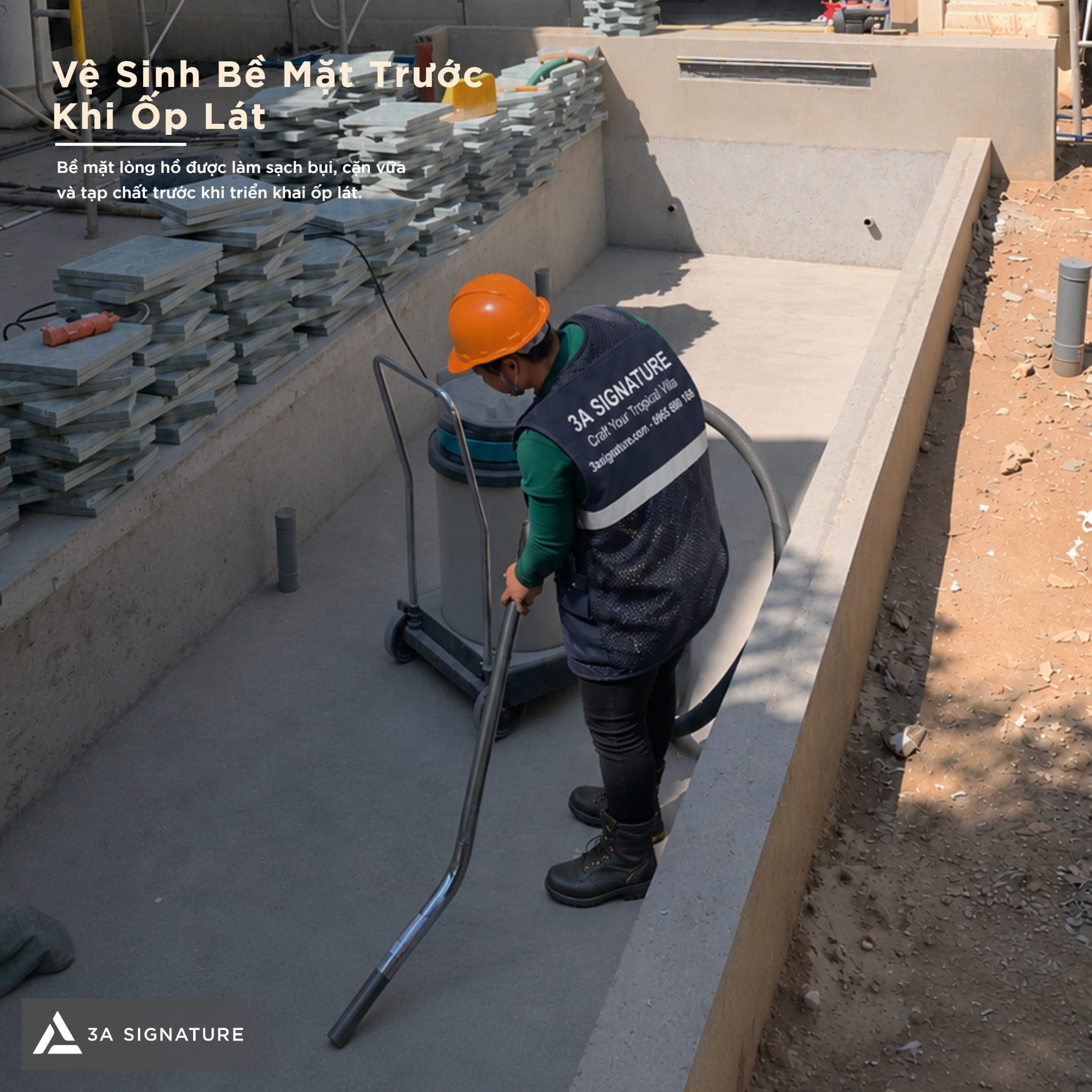
In addition to cleaning, it is necessary to verify the flatness, elevation, and stability of the substrate, as well as the condition of the waterproofing layer, in accordance with the technical specifications. For areas frequently exposed to water, the substrate must be suitable for receiving tiling materials and compatible with the adhesive system being used. Areas around pipe penetrations, utility connection points, or transitions in elevation must be inspected before proceeding with the tile installation phase.
Positioning Tiles According to Centerlines and Design Elevations
Following the completion of substrate preparation, the technical team proceeds to position the tiles based on actual dimensions and the planned joint layout. For the tiling of the swimming pool at Lumina Retreat Villa, laser equipment is utilized to ensure precise control over reference lines, elevations, and the continuity of surfaces. This critical step helps prevent misalignment of tile joints when covering large areas.
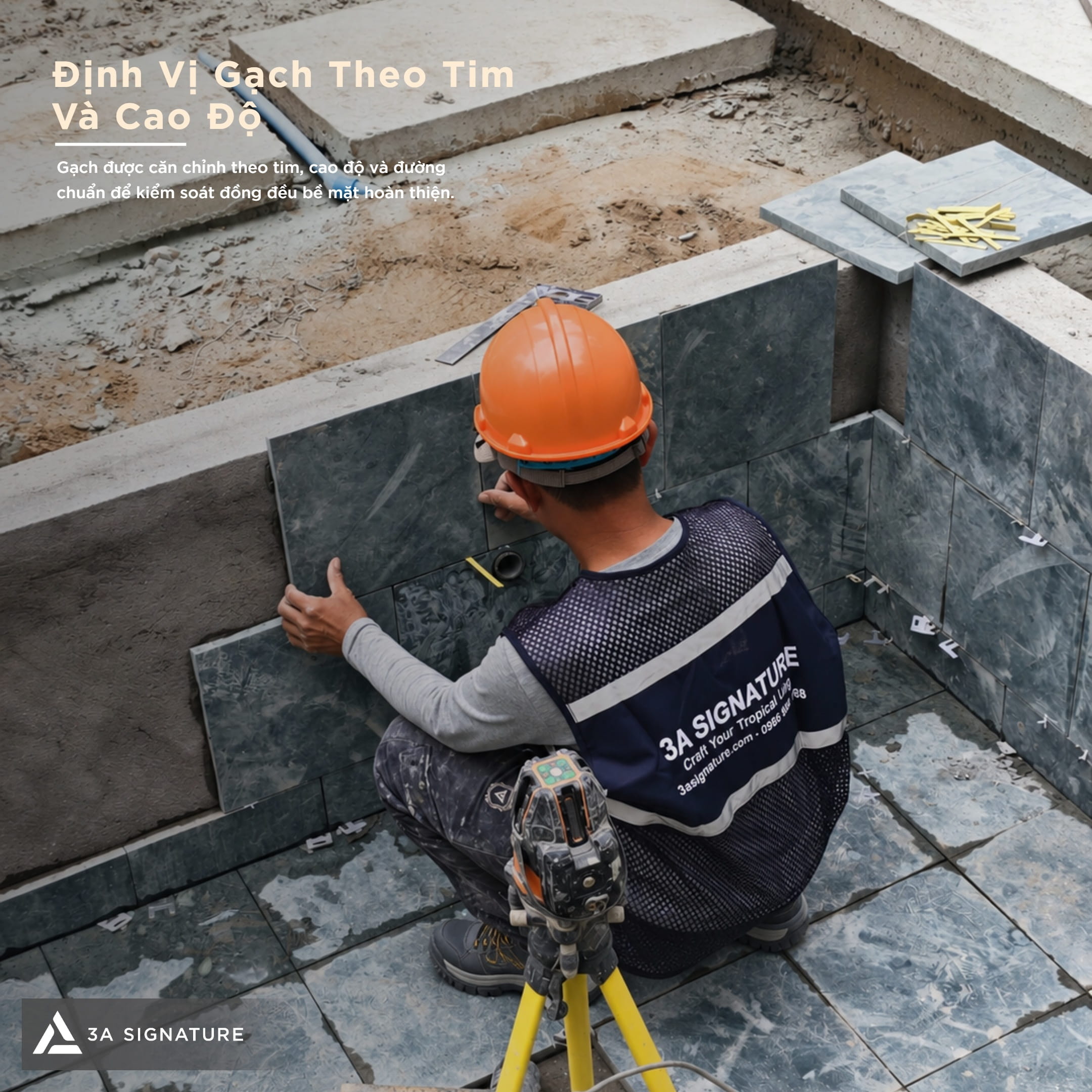
The tile layout must account for tile dimensions, corner junctions, termination points, and areas containing technical piping. For tiles adjacent to the pool edge, careful consideration should be given to how they are cut and fitted to maintain consistent proportions and avoid the appearance of excessively narrow tile strips in highly visible areas. The construction team must verify the tile layout plan before final installation, ensuring a cohesive and well-executed finish.
Preparing Adhesive and Managing Bonding Performance
The adhesive serves as an intermediate layer that determines the bond between the tiles and the substrate. For the tiling of the swimming pool at Lumina Retreat Villa, the adhesive must be carefully selected based on factors such as constant water immersion, the specific type of tiles used, and the existing waterproofing system. The mixing process must strictly follow the manufacturer’s instructions regarding water-to-powder ratios, mixing duration, and the allowable working time after preparation.

During installation, the amount of adhesive must be carefully controlled to minimize voids behind the tiles. Depending on the size and material properties of the tiles, the installation team should select an appropriate adhesive application method to ensure the required coverage and adhesion. Particular attention must be paid to corners, the base of the pool walls, and all joints, as these areas are directly exposed to water during use.
Execution of Tiling for the Pool Interior by Section
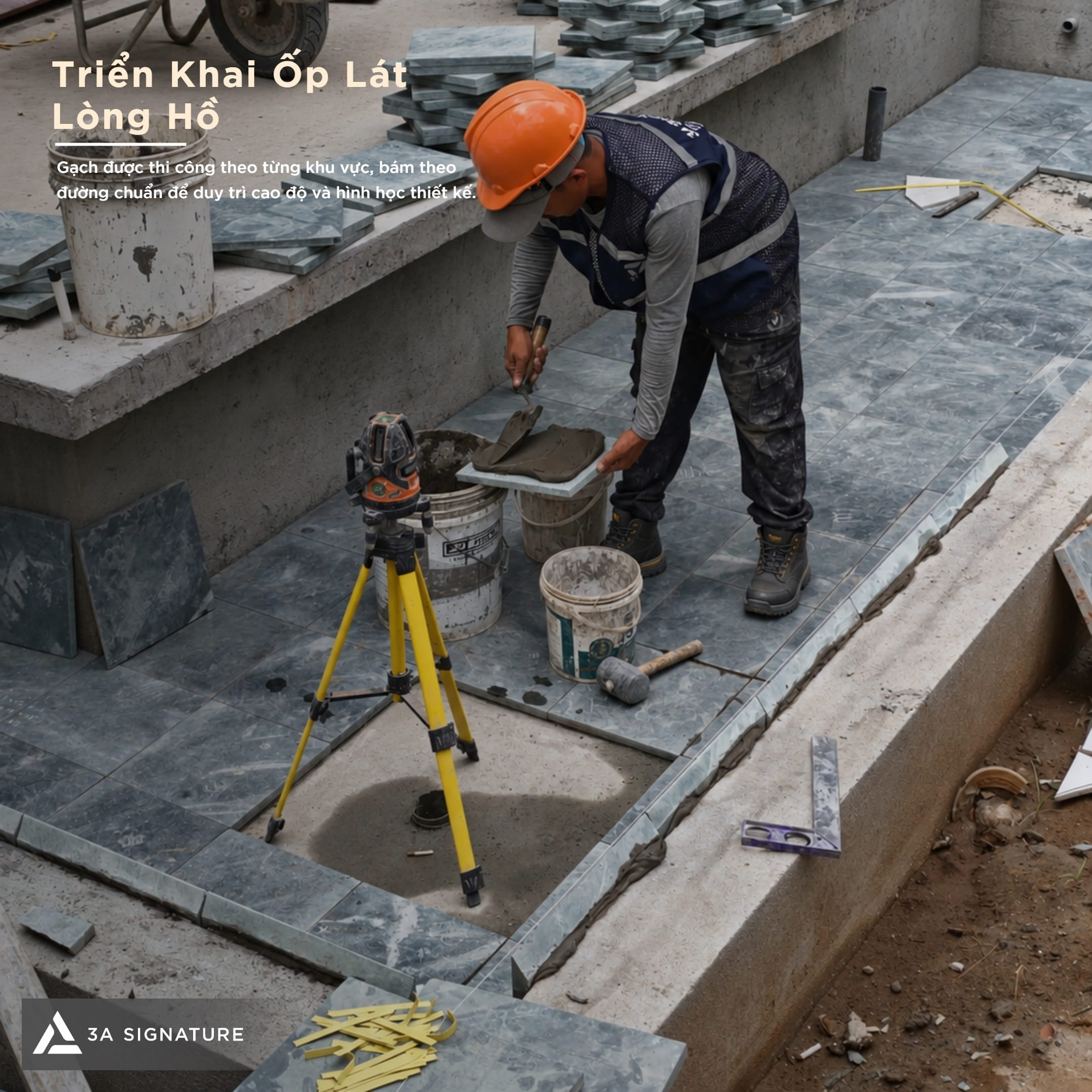
The tiling process for the pool at Lumina Retreat Villa is carried out in distinct sections to facilitate the precise control of elevations and reference lines. Each tile is placed according to the design, aligned with adjacent tiles, and checked for stability before proceeding to the next area. This sequence helps minimize the accumulation of deviations across the entire pool floor and walls.
On-site, the team utilizes laser tools in conjunction with alignment instruments to verify the flatness of the surface, the width of the grout joints, and the positioning of the tiles. Areas surrounding pre-installed piping must be handled with care to avoid compromising any technical components. For the pool floor, the elevation and drainage slope are cross-referenced against the construction drawings to ensure the pool remains easy to clean and functions correctly once in operation.
Controlling Surface Evenness and Grout Joint Consistency
Surface flatness and the consistency of grout joints are key criteria that must be monitored during the tiling of the swimming pool at Lumina Retreat Villa. Adjacent tiles must be aligned to minimize lippage uneven edges between tiles while ensuring that the grout joint spacing adheres to the specified design. This inspection is conducted during the installation process, while the adhesive remains in a workable state that allows for adjustments.
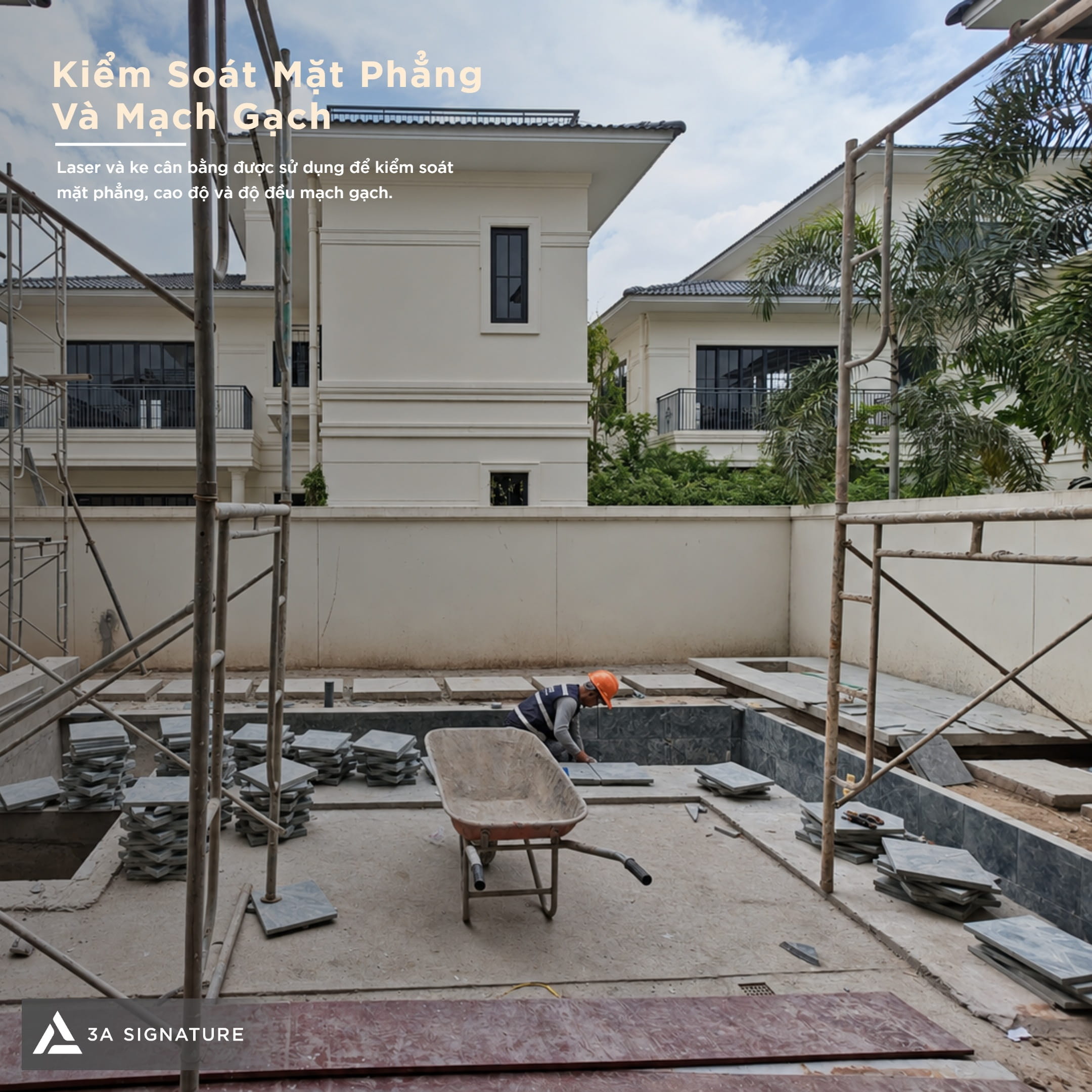
Beyond the pool floor, the wall cladding must be inspected for vertical and horizontal alignment, as well as continuity at the corners. When using stone-effect tiles, the arrangement of color tones and the orientation of the veining significantly influence the overall aesthetic. 3A Signature carefully coordinates the placement of individual tiles to ensure a harmonious surface that aligns with the color palette and the atmospheric vision of Lumina Retreat Villa.
Handling Tile Edges, Terminations, and Junctions
Pool edges and termination points are areas where any imperfections are easily noticeable. For the tiling at Lumina Retreat Villa, these sections are precisely aligned against reference lines to maintain consistent elevation, straightness, and seamless transitions between horizontal and vertical surfaces. Any cut tiles are sized accurately, ensuring clean edges and uniform, consistent finishes.
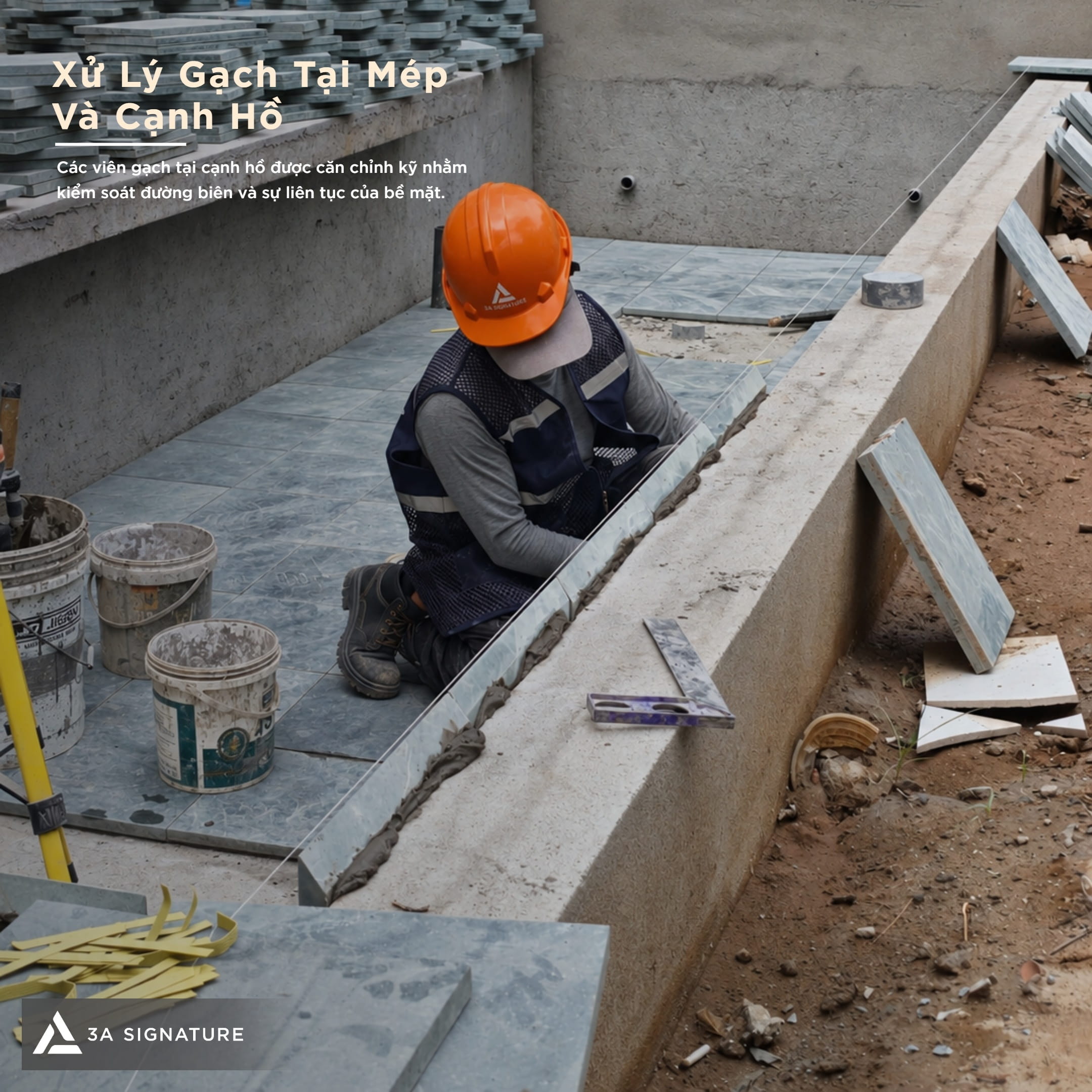
At corners and junctions with other structural elements, the method for treating gaps must account for potential movement and exposure to water. Any penetrations through the finish layer—such as those for the filtration system—must also be carefully reviewed to ensure they do not obstruct the future installation of equipment. Proper detailing in these areas helps maintain aesthetic quality while facilitating future maintenance.
Surface Inspection Following Tiling and Preparation for Grouting
Once the tiling for the Lumina Retreat Villa pool is installed, the entire surface must undergo a comprehensive inspection before grouting begins. Key aspects to evaluate include surface flatness, elevation, the uniformity of tile joints, the placement of cut tiles, and the junctions along the pool walls. The tiled surface must be protected while the adhesive cures in accordance with the manufacturer’s specifications to prevent any displacement of the tiles.
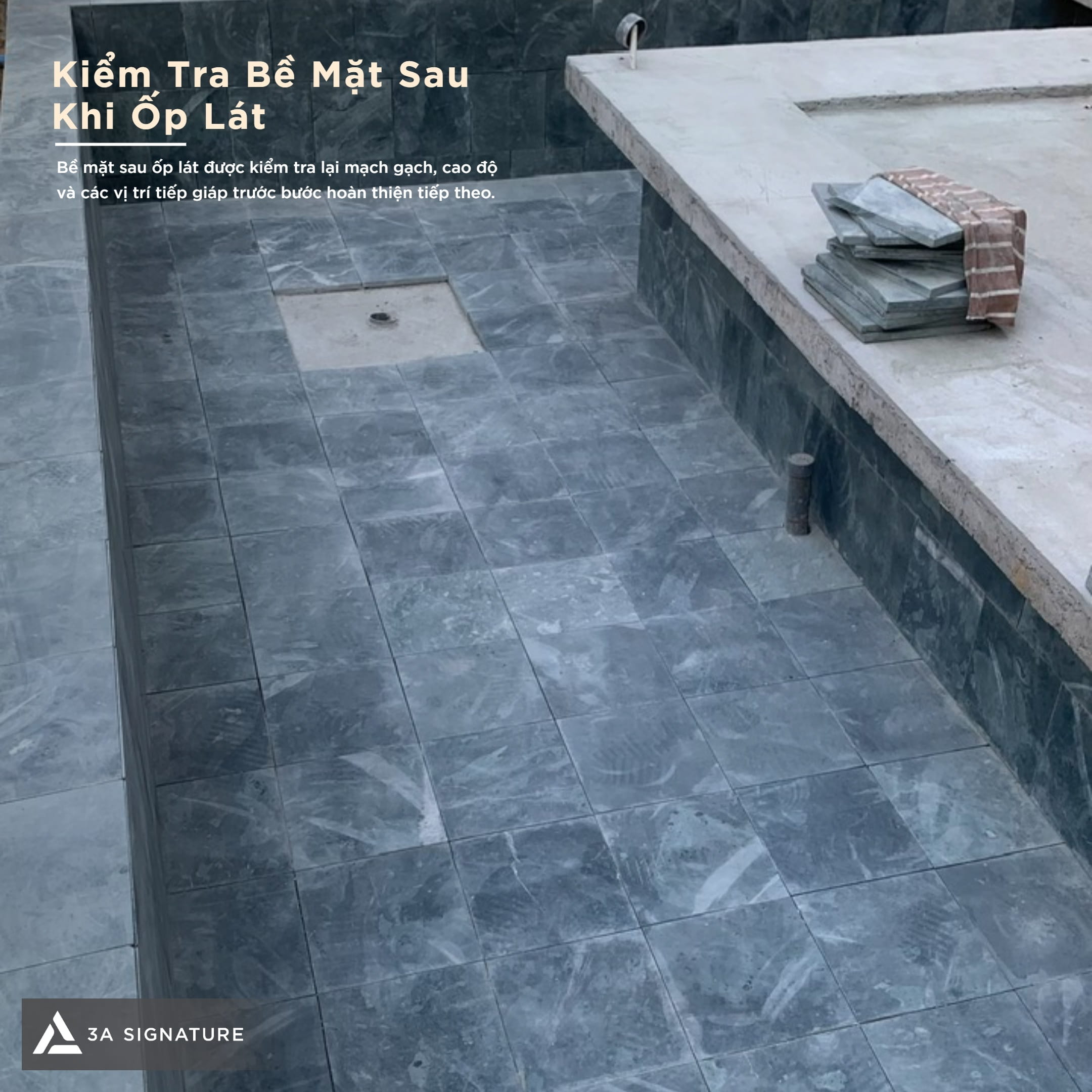
Grouting should only be carried out once the adhesive layer has met the required technical specifications. The grout material must be suitable for an environment involving constant water immersion and the specific operational requirements of an aquarium. Upon completion, the tiling system must undergo a formal inspection and acceptance process, which includes cleaning, checking areas where pipes penetrate the structure, and verifying the watertight integrity of the entire aquarium system in accordance with the technical plan before it is put into operation.
Conclusion
The tiling of the pool at Lumina Retreat Villa is a finishing phase that requires the careful coordination of construction techniques, materials, and the pool’s operational systems. From cleaning the substrate and establishing reference axes to preparing adhesives, aligning tile joints, and addressing transition areas, every step must be managed in accordance with the specific conditions on-site.
At 3A Signature, the quality of the final result is ensured through continuous inspection at every stage. By executing the tiling of the Lumina Retreat Villa pool in the proper sequence, a solid foundation is established for the subsequent finishing steps, final inspection, and the eventual commissioning of the landscape system.