

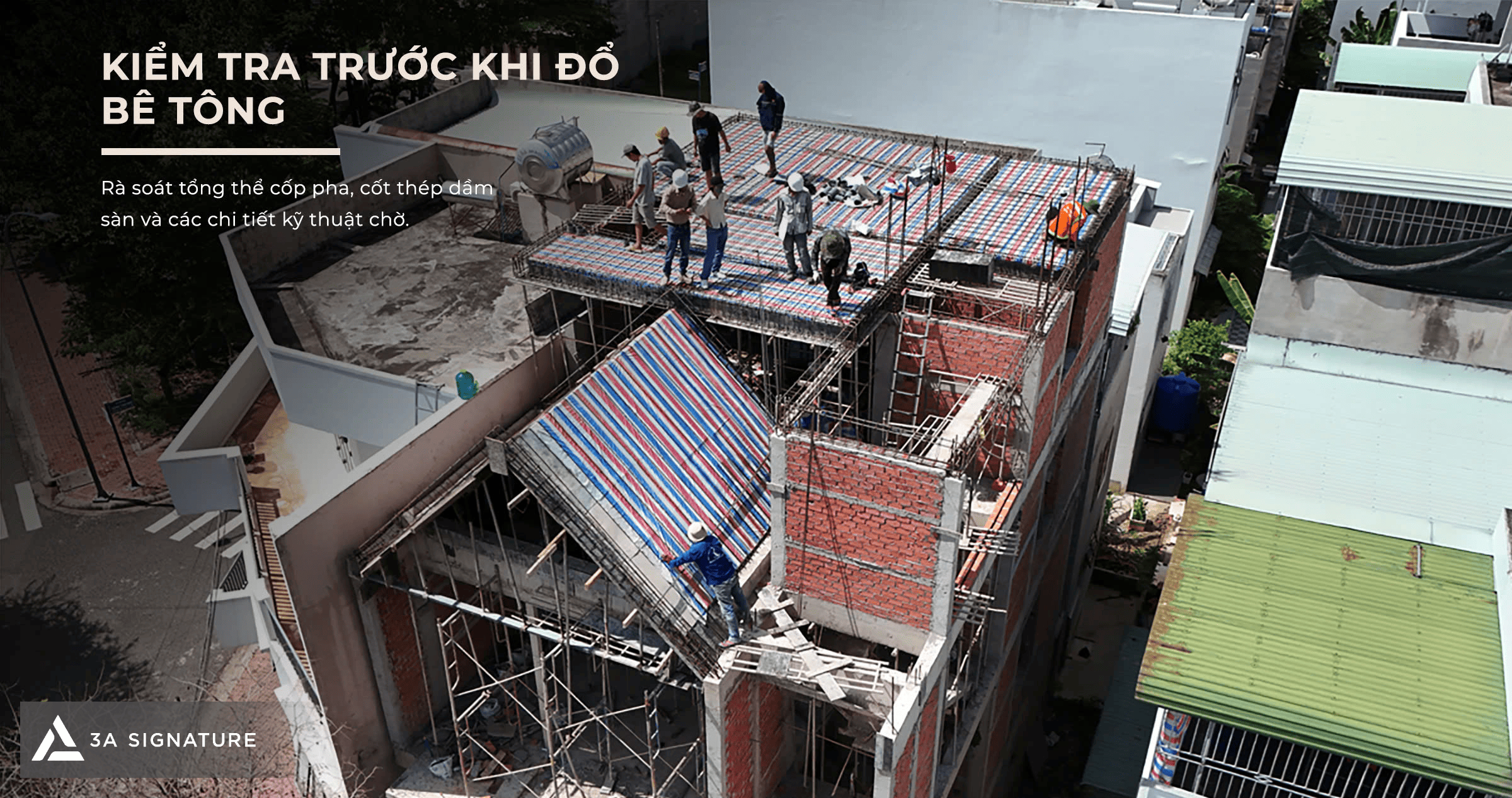
Prior to concrete pouring, the inspection of formwork and reinforcement at Alchem Villa is a crucial step for verifying the entire beam-and-slab system, elevations, technical openings, and MEP provisions. This essential quality control measure enables 3A Signature to minimize discrepancies before the concrete covers the structural elements, thereby establishing a stable foundation for subsequent construction phases.
Inspecting Formwork and Reinforcement at Alchem Villa Before Proceeding to the Next Construction Stage
In structural construction, the phase immediately preceding concrete pouring serves as a critical inspection milestone. Once concrete is placed, the majority of the reinforcement, formwork, additional reinforcement bars, openings, and technical sleeves will be concealed. Therefore, a thorough inspection of the formwork and reinforcement at Alchem Villa is essential before the project advances to the concrete pouring stage.
At Alchem Villa, the 3A Signature technical team conducts a comprehensive review of the beam and slab layout from multiple perspectives. From pitched roof areas and flat slab sections to structural junctions, the entire reinforcement and formwork system is verified against the approved construction drawings. This process helps identify areas requiring finishing touches or adjustments, as well as confirming readiness for the next phase.
Given the villa’s complex spatial layout, the inspection of formwork and reinforcement extends beyond a mere visual check of the slab surface. The technical team must cross-check specific groups of structural elements: perimeter beams, main beams, secondary beams, slab panels, openings, utility pipe sleeves, and MEP-related locations. Any discrepancies at this stage could impact the subsequent finishing work.
Comprehensive Review of the Beam-Slab System at the Construction Site
An overview of the site reveals that the Alchem Villa beam-slab system is being organized across various zones. Sections of the slab are covered with protective sheeting, alongside the steel reinforcement for the beams and slabs that was installed prior to inspection. This is an opportune moment for the technical team to verify the construction scope, slab panel locations, and the continuity of the structural system.
During the inspection of the formwork and reinforcement at Alchem Villa, the beam-slab areas are reviewed zone by zone. Slab panels must be checked for geometry, elevation, and boundary positioning. The underlying formwork system must be stable and adequately shored to withstand the loads imposed during concrete pouring. Inspections require even greater precision in areas featuring sloped roofs or complex geometric forms, as dimensional deviations could directly impact the final architectural profile.
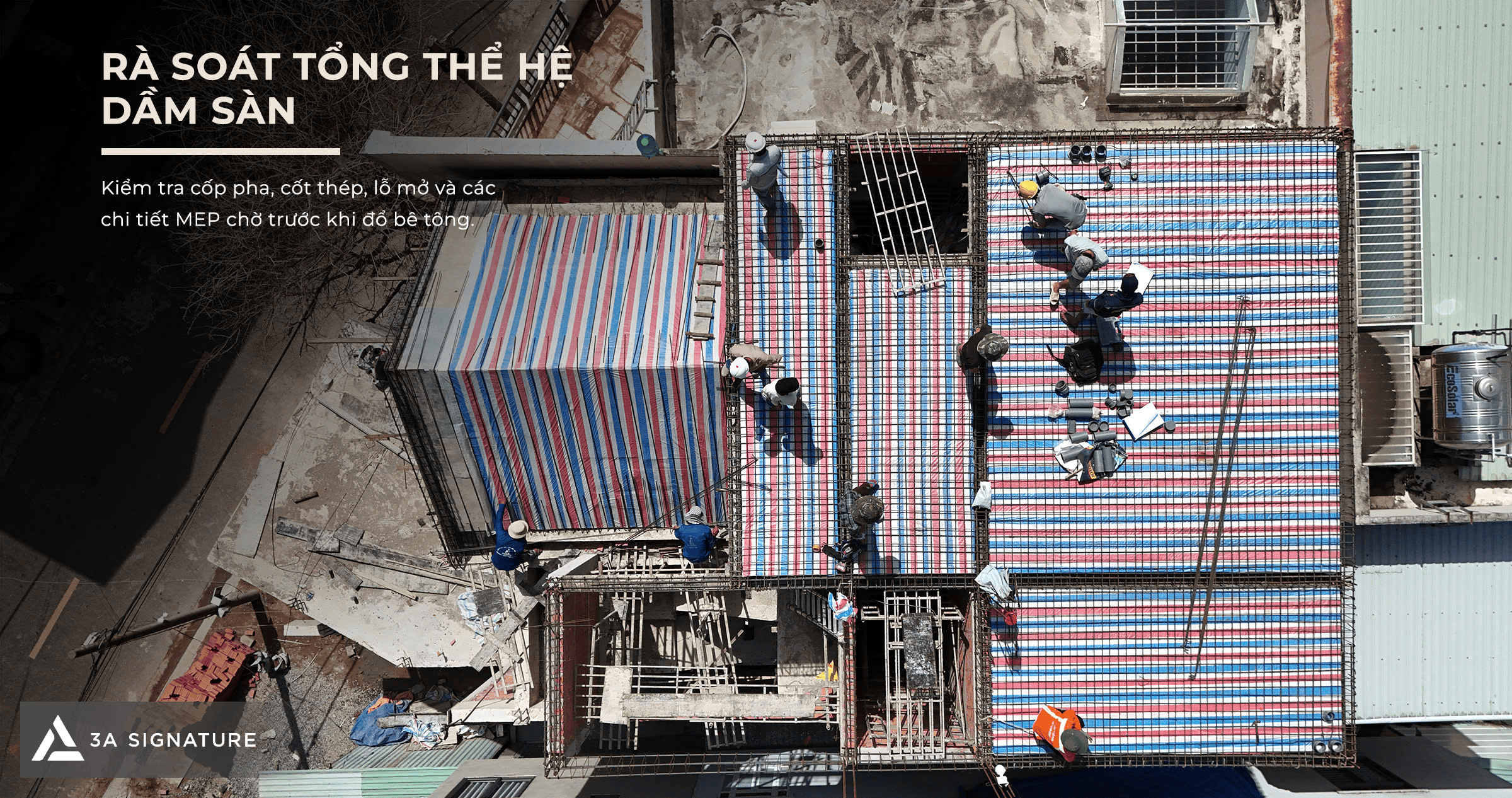
A comprehensive review also enables the construction team to organize access routes, equipment staging areas, and methods for placing concrete on the deck. With a clear understanding of the site layout, construction can proceed in a more logical sequence, minimizing interference between different work crews.
Inspection of Beam and Slab Reinforcement Against Construction Drawings
Reinforcement is a critical load-bearing component of reinforced concrete structures. Prior to concrete pouring, the technical team must verify dimensions, spacing, layout, and the placement of additional reinforcement bars in accordance with the construction drawings. This is a key aspect of the formwork and reinforcement inspection process at Alchem Villa.
On-site, engineers conduct direct measurements and checks to verify the details of the beam and slab reinforcement. Critical areas—such as slab edges, beam-slab junctions, and locations near openings or points of concentrated load—require thorough review. If any reinforcement is found to be incorrectly positioned or inadequately connected, the construction team must rectify the issue before the formal inspection and acceptance process.

The inspection of reinforcement also involves the concrete cover. The reinforcement assembly must be properly supported, tied, and secured to minimize displacement during concrete pouring. If the reinforcement shifts during construction, the thickness of the concrete cover and the structural performance of the element could be compromised. Therefore, an inspection of the formwork and reinforcement at Alchem Villa must be conducted before concrete is placed on the slab.
Inspection of Formwork, Shoring Systems, and Construction Elevations
Formwork and shoring systems serve as temporary structures that play a direct role in shaping concrete elements. Prior to concrete pouring, the formwork system must be inspected for stability, tightness, elevation accuracy, and its ability to maintain the intended geometry of beams and slabs.
During the inspection of the formwork and reinforcement at Alchem Villa, the technical team reviews connection points, mold edges, beam sides, and areas where elevations change. These locations are prone to grout leakage, formwork sagging, or dimensional deviations if not properly controlled from the outset. For a villa project with high architectural standards regarding form and massing, the stability of the formwork directly impacts the quality of the concrete surface and subsequent finishing layers.
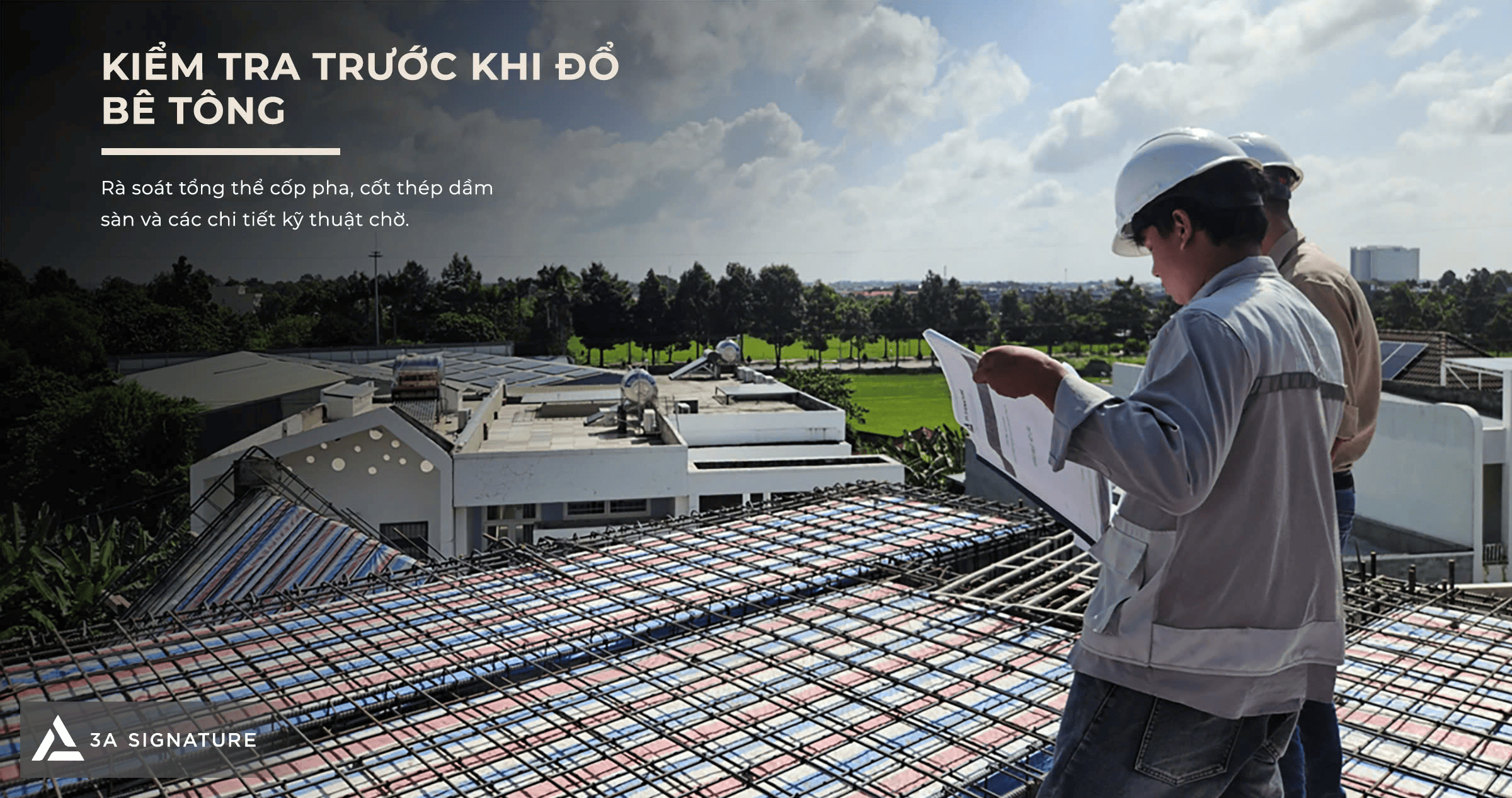
Verifying the floor elevation is also a necessary step prior to concrete pouring. Checking the elevation ensures that the flooring in functional areas aligns with the design specifications and establishes the necessary basis for subsequent stages, such as waterproofing, screeding, tiling, and interior installation.
Verifying Openings and MEP Provisions
Openings and MEP (Mechanical, Electrical, and Plumbing) provisions are critical areas requiring careful attention during the construction of floor beams and slabs. Electrical systems, plumbing, floor drains, floor penetrations, and other technical connection points must be precisely located before concrete is poured. Any omissions or misplacements could necessitate remedial work that compromises structural integrity or leads to increased construction costs.
At Alchem Villa, openings and MEP connection points are inspected alongside the reinforcement steel. This is a vital step in the formwork and reinforcement inspection process, as structural and MEP drawings must be fully coordinated. MEP sleeves and conduits must be positioned exactly according to the design, ensuring they do not conflict with load-bearing reinforcement or compromise critical structural zones.
Inspecting MEP elements prior to concrete pouring also minimizes the need for subsequent demolition or cutting. For 3A Signature, this is a fundamental principle in villa construction: meticulous attention to detail in the concealed layers ensures the smooth execution of subsequent finishing work.
Collaborative Inspection Prior to Acceptance
The inspection process prior to concrete pouring is not the task of a single team alone. Technical, supervisory, and construction teams, along with other relevant parties, must jointly cross-reference documentation, review site conditions, and reach a consensus on necessary actions. This collaborative approach helps minimize discrepancies that might arise from the differing perspectives of various disciplines.
During the inspection of formwork and reinforcement at Alchem Villa, direct on-site communication facilitates the rapid identification of issues. Engineers can cross-reference drawings right at the work location, inspect completed sections, and request adjustments if any non-conformities are detected. Specific details such as reinforcement placement, openings, MEP connection points, slab edges, and structural junctions must all be verified before formal acceptance.

This step also helps manage the construction schedule. By addressing technical issues before concrete is poured, the need for remedial work after the structural elements are completed can be minimized. This is particularly important for high-end villa projects, where every stage of construction is closely linked to the quality of the final finish.
Structural Quality Control: The 3A Signature Approach
At 3A Signature, the structural phase is viewed not merely as the building’s foundation but as the critical basis for the stability of all subsequent finishing works. A properly inspected structural framework facilitates waterproofing, floor screeding, tiling, MEP installation, and interior fit-out. Conversely, structural deviations often lead to significant costs and delays during later stages.
Consequently, the inspection of formwork and reinforcement at Alchem Villa is a mandatory control step prior to concrete pouring. Every detail is reviewed systematically: site conditions, reinforcement, formwork, openings, MEP coordination, and the verification of acceptance criteria.
This approach reflects 3A Signature’s philosophy of controlled construction: prioritizing the seamless integration of design, engineering, and on-site execution over mere speed.
Conclusion
Inspecting the formwork and reinforcement at Alchem Villa is a critical step in the structural construction phase, particularly prior to the concrete pour for beams and slabs. Every detail from the formwork system, reinforcement, and elevations to technical openings and MEP connection points must be thoroughly reviewed before the concrete encases the structural elements.
At 3A Signature, quality control does not begin at the finishing stage; rather, it is implemented right from the initial structural layers. This approach ensures steady progress for Alchem Villa in strict accordance with technical specifications, laying a solid foundation for the subsequent finishing phases.